Remedies & combinations
The 8, 9 & 10 Mukhi Combination: Understanding Kaal Sarp Dosh in Tradition
In Vedic astrology, Kaal Sarp Dosh is among the more discussed planetary configurations — and for centuries, a specific combination of Rudraksha beads has been worn on the guidance of astrologers and pandits in response to it.
Amorfos · 5 min read
There are certain subjects in Vedic astrology that carry real weight in the lives of those who encounter them. Kaal Sarp Dosh is one of them. If you have sat across a learned jyotishi and heard this term spoken about your chart, you may have left that conversation with questions. What does it actually mean? Where does the tradition of wearing kaal sarp dosh rudraksha come from? And what is the significance of the specific beads that astrologers most often recommend?
This piece is an attempt to answer those questions simply and honestly — drawing on traditional understanding, not on promise or prescription.
What Kaal Sarp Dosh Means in Vedic Tradition
In classical Jyotish, the birth chart is a map of planetary positions at the moment of one's arrival in the world. Rahu and Ketu — the two lunar nodes, referred to in tradition as the shadow planets — occupy opposite points on this chart at all times. When all seven of the visible planets (Sun, Moon, Mars, Mercury, Jupiter, Venus, and Saturn) fall within the arc between Rahu and Ketu on one side, this configuration is called Kaal Sarp Yoga or Kaal Sarp Dosh.
The word Kaal refers to time, and Sarp to the serpent — an ancient symbol that in Indian cosmology represents cycles, karmic continuity, and the unseen forces that shape a life. The configuration is considered significant because it is believed, in astrological tradition, to intensify the influence of Rahu and Ketu in a person's life — planets associated with past-life karma, unexpected reversals, delays, and periods of deep introspection.
It is worth noting that the presence of this dosh in a chart is not uniformly read as inauspicious by all jyotishis. Several historical figures and leaders are said to have carried this combination in their charts. The tradition acknowledges nuance. What most astrologers do agree on is that the influence of Rahu and Ketu deserves conscious attention — and that certain upays, or traditional measures, may be observed on their guidance.
The Traditional Role of Rudraksha in Astrological Upay
Rudraksha beads have been referenced in texts such as the Shiva Purana, the Padma Purana, and the Srimad Devi Bhagavatam across centuries. Their use as a form of upay — a traditional astrological or spiritual observance — is well established in the subcontinent. Pandits and astrologers across different schools of thought have long associated specific mukhis, or facets, of the Rudraksha bead with particular planets, deities, and energetic qualities.
The recommendation of a Rudraksha combination is not a medical suggestion, nor does it carry the nature of a promised outcome. It is a traditional practice — an act of alignment with intention, observed within a broader framework of spiritual discipline and astrological guidance.
The 8, 9, and 10 Mukhi Combination: What Each Bead Represents
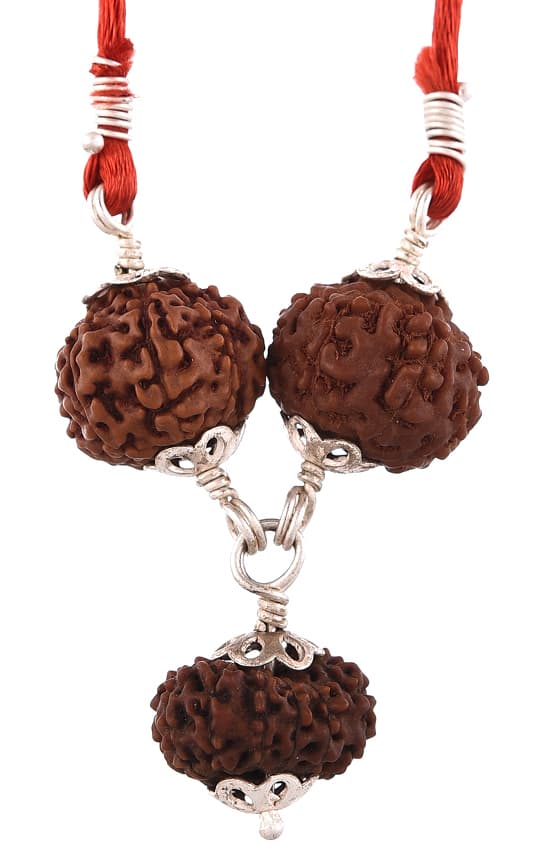
The combination most widely recommended by astrologers and pandits in the context of Kaal Sarp Dosh comprises three beads: the 8 Mukhi, the 9 Mukhi, and the 10 Mukhi Rudraksha. Each carries its own traditional associations.
- 8 Mukhi Rudraksha: Traditionally associated with Lord Ganesha and the planet Rahu. The eight-faced bead is held, in tradition, to invoke the qualities of Ganesha — the remover of obstacles, the keeper of thresholds — and to work in alignment with the energy of Rahu, one of the two nodal planets central to Kaal Sarp Dosh.
- 9 Mukhi Rudraksha: Associated with Goddess Durga (in her nine forms, the Navadurga) and with the planet Ketu. Ketu, the south node, is the second of the two shadow planets that define the Kaal Sarp configuration. The nine-faced bead is traditionally worn to invoke the protective and clarifying qualities associated with the Goddess.
- 10 Mukhi Rudraksha: Associated with Lord Vishnu, the preserver in the Hindu trinity. The ten-faced bead does not correspond to a single planet in the way other mukhis do; rather, it is held to carry the balancing, harmonising presence of Vishnu across all planetary influences — making it a natural companion in a combination intended to address a broad planetary alignment.
The Rudraksha is not an object of superstition. It is an object of tradition — one that has been held, worn, and passed down through generations as part of a living practice of intention and reverence.
How the Combination Is Typically Worn
Astrologers and pandits who recommend the kaal sarp dosh rudraksha combination generally advise that the three beads — 8, 9, and 10 Mukhi — be strung together and worn as a pendant or bracelet, often in silver or copper wire, close to the skin. The day of first wearing is typically guided by the astrologer, with Monday and specific auspicious dates during Shravan being commonly recommended. Many pandits also suggest a brief abhishek, or ritual consecration, before the beads are first worn.
It is always advisable to consult a learned jyotishi before adopting any astrological upay. The combination described here is a widely acknowledged traditional recommendation — but the specifics of how it is worn, on which day, and alongside what other practices should be determined by qualified astrological guidance tailored to your individual chart.
A Note on Authenticity
The Rudraksha market in India is, unfortunately, not without its inconsistencies. Beads of varying quality and provenance are sold under the same names. At Amorfos, every bead in this combination — and across our collection — is Lab Certified for authenticity. We source primarily from Nepal, where the high-altitude climate produces beads of particularly dense mukhis and deep natural striations. The certification process involves physical and structural analysis to confirm that each bead is genuine Elaeocarpus ganitrus — the botanical species that constitutes true Rudraksha.
When you wear a bead from Amorfos, you wear one whose authenticity has been verified. What you bring to it — the intention, the practice, the relationship with your own tradition — is entirely your own.
Closing Thought
Kaal Sarp Dosh is not a sentence. In Vedic tradition, it is a configuration — one among many — that invites awareness and considered response. The 8, 9, and 10 Mukhi Rudraksha combination represents centuries of accumulated astrological guidance. It is worn not as a shortcut, but as a conscious act: a way of holding certain intentions close to the body, and of participating in a tradition that stretches back further than any of us can trace.
Good to know
- Who recommends wearing the 8, 9, 10 Mukhi Rudraksha combination for Kaal Sarp Dosh?
- This combination is traditionally worn on the recommendation of astrologers and pandits who identify Kaal Sarp Dosh in an individual's birth chart. It is always advisable to consult a qualified jyotishi before adopting any astrological upay, as guidance should be tailored to your specific chart.
- Are the Rudraksha beads in Amorfos's Kaal Sarp Dosh combination authentic?
- Yes. Every bead in our Kaal Sarp Dosh combination is Lab Certified for authenticity. The certification process physically and structurally verifies that each bead is genuine Elaeocarpus ganitrus — the botanical species that constitutes true Rudraksha. We do not list or endorse the specific lab by name.
- What is the return and shipping policy for this combination?
- We offer a 7-day return window on unused, sealed products. Orders above ₹999 qualify for free shipping across India. Please refer to our full returns policy page for complete details.
Rudraksha is traditionally worn on the recommendation of astrologers and pandits. We make no medical or miraculous claims. Every Amorfos bead is Lab Certified for authenticity and origin.